How to Specify a 4U GPU Server Chassis Before You Request a Quote
A practical checklist for specifying a 4U GPU server chassis: GPU length and slot width, PCIe slots, drive bays, cooling layout, power redundancy, and motherboard form factor.
By Mark Lee, Technical Sales and Platform Configuration, GPUBAREBONE
If you have decided on a 4U GPU chassis and the next step is to ask for a price, this article is about the step in between. "4U" fixes a height and nothing else — the four 4U platforms compared below differ by 250 mm of depth, by three different storage architectures and by three different power philosophies. It is written for integration engineers who are assembling the specification that a supplier will price from. It is not for buyers who have not settled the GPU model, and it does not cover 5U, 6U or 7U directions. What you get is a twelve-field specification sheet you can complete before the first conversation, plus the four questions that change the answer most. It cannot tell you what your configuration will cost or how it will perform; those come after the configuration is fixed.
1. "4U" is a height, not an envelope
A 4U specification tells a supplier that the chassis is 177 mm tall. It does not tell them the depth, the storage architecture, the fan arrangement, the power shelf, the board support or the GPU envelope.
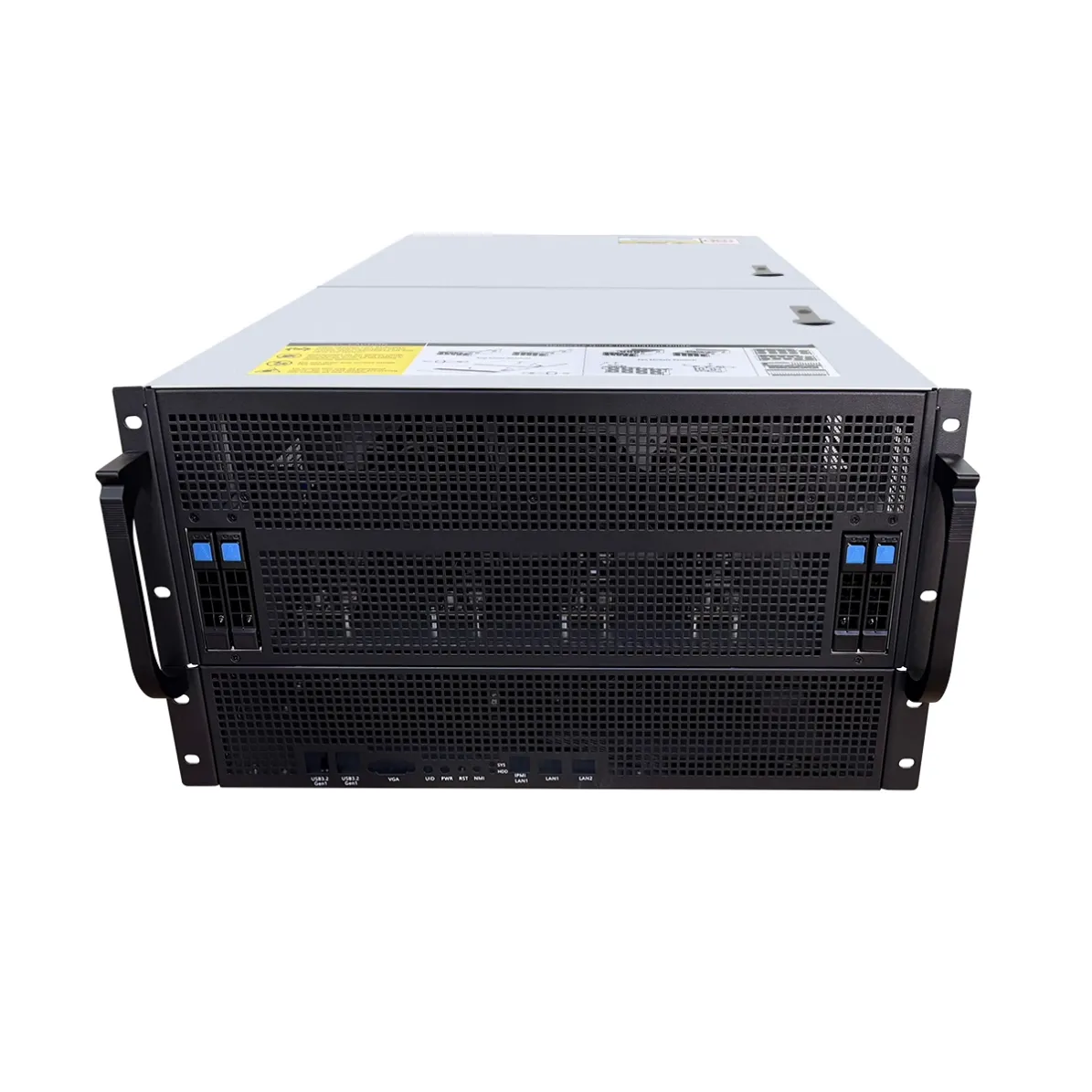
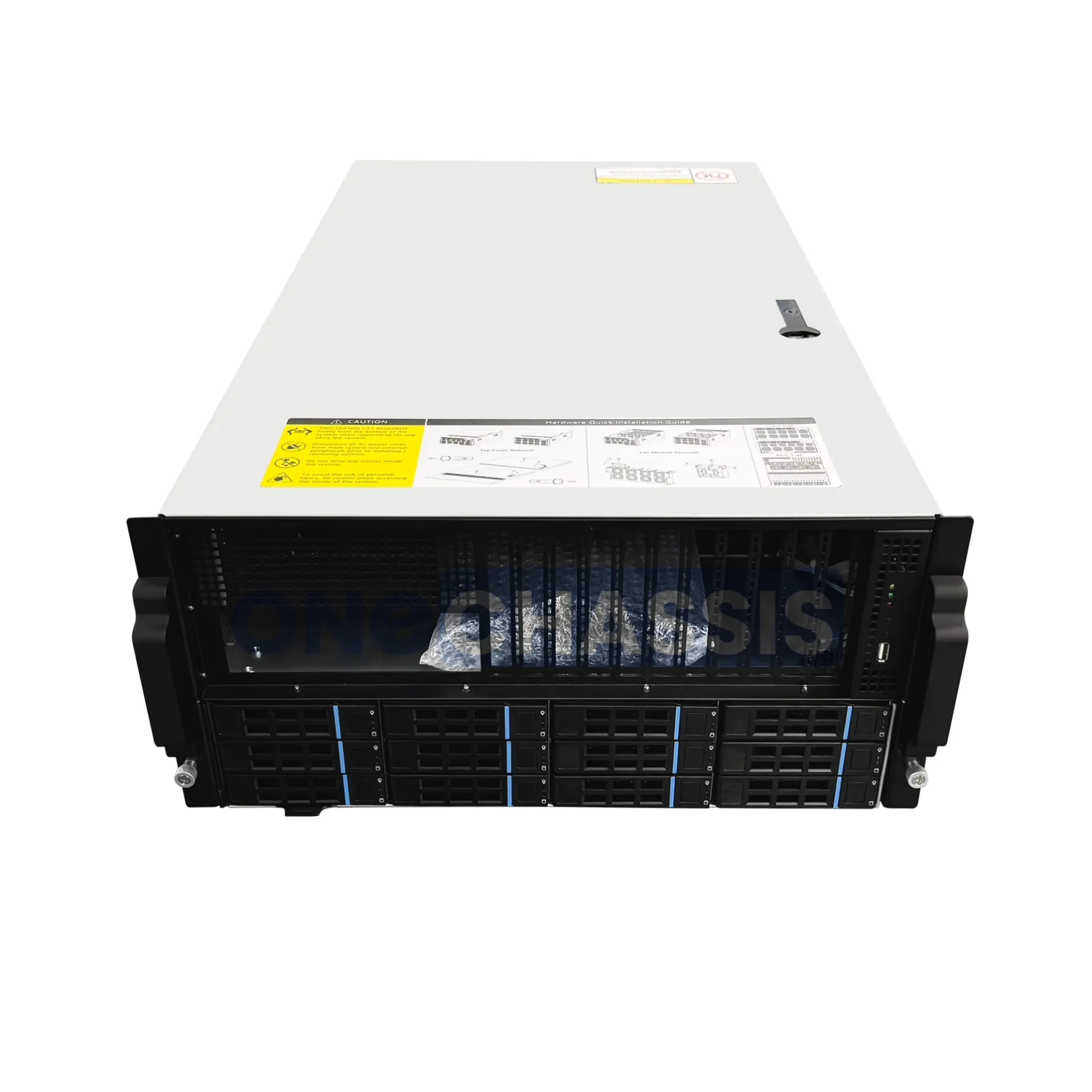
That gap is bigger than most buyers expect. In the current range, three 4U platforms share essentially the same height and still differ in depth from 530 mm to 780 mm — a 250 mm spread that decides whether the unit fits your cabinet. They also differ in drive count from four bays to twelve, in fan architecture from five fans to six, and in power from a single 2U supply to 1+1 redundant CRPS units up to 2700 W.
So the useful question is not "do you have a 4U chassis". It is "here is my twelve-field specification; which direction fits it".
2. How the specification goes wrong
The failure is rarely a single wrong number. It is a specification that was never completed.
- The person carrying this is usually the integration engineer who will assemble the node, and is compiling a specification while the GPU model and cabinet are already fixed.
- The specification usually gets expressed as a form factor plus a GPU count, because that is what the platform family names suggest.
- What is actually missing is the depth, the board model, the drive topology, the fan and power architecture, and the card's installed dimensions including connector clearance.
- Without those, the next stage becomes an exchange of generic datasheets rather than a fit check, and the supplier can only price a standard configuration rather than yours.
- Each round costs calendar time, and the node waits on a specification that was never complete enough to be answered.
- The decision available here is to complete the twelve fields below so the first supplier conversation starts from your configuration instead of theirs.
3. The twelve fields to confirm
Complete these before the first conversation. Each one changes at least one dimension of the answer.
Envelope
- Chassis depth, measured against your cabinet's usable depth between mounting rails. This is the field that most often eliminates a model. A 530 mm platform and a 780 mm platform are both 4U and are not interchangeable in a shallow cabinet.
- GPU count and interface generation. Count alone is not enough: the same count at PCIe 5.0 x16 versus an earlier generation changes the riser set, the cable set and often the board support list. PCI-SIG publishes the generation specifications, which is what to compare against when a card and a platform disagree.
- Installed GPU dimensions, not just the card's body length. Length plus power-connector clearance, height including connector seating, and slot width per card. A platform specified for a 355 mm card body is telling you the body fits, not the assembly. Take the body figures from the vendor's own datasheet — NVIDIA H100 and RTX PRO 6000 both publish them — then add the connector clearance yourself.
- Slot width in the platform's own terms. Platforms describe this differently — one may say "triple-slot or 4-slot support", another may express GPU spacing as 92 mm or 85 mm. Convert your card into the terms the platform uses.
Platform fit
- Exact motherboard model, including revision. A platform that lists "ATX / EATX (EPYC / Xeon)" is making a wider claim than one that names four specific boards, and the named-list platform is telling you which boards were designed in.
- Cooler height limit. This is frequently unpublished and frequently decisive. Where a platform publishes a maximum cooler height, that number governs your CPU cooling choice before the GPU choice.
- Expansion slot count and form. Full-height slot count is what determines whether your non-GPU cards fit: NICs, HBAs, capture cards. A platform with eleven full-height slots is making a different promise from one with fewer.
Storage, power and cooling
- Drive bays and backplane topology. Bay count is the visible number; the backplane is the decision. Direct-connect and expander backplanes support different topologies, and an NVMe mix is a separate option rather than a default.
- Power architecture, not just wattage. A single 2U supply, a 1+1 redundant pair and a multi-module CRPS shelf are three different products. Wattage without the redundancy topology does not describe the supply.
- Fan architecture and zoning. Count the zones, not the fans. Front intakes plus a rear set is a different airflow design from a mid-mounted fan wall, and the GPU zone is the one that limits sustained performance.
- Supply scope. Chassis only, or configured barebone. The include/exclude line differs per platform and it determines what your own team must source and validate.
- Rack interface. Rail type and rated load, plus cabinet depth and cabling space behind the rear rail. The relevant weight is the completed system, not the empty chassis.
4. Four 4U directions in this range
The table compares four published 4U platforms. Empty cells are genuinely unpublished, not estimates.
| OCG4U530A-L | OCG4660-4H12-C | OCG4680-4H8-H | OCG4780-4H5-H | |
|---|---|---|---|---|
| Depth (L) | 530 mm | 660 mm | not published | 780 mm |
| Dimensions (W × D × H) | 435 × 530 × 177 mm | 438.4 × 660 × 177 mm | not published | 436 × 780 × 177 mm |
| GPU support | not published | not published | 4 × dual-slot turbo | up to 4; triple-slot or 4-slot |
| Max GPU length | not published | not published | not published | 355 mm body |
| Expansion slots | 11 × full-height | 11 × full-height PCIe | 11 × full-height | not published |
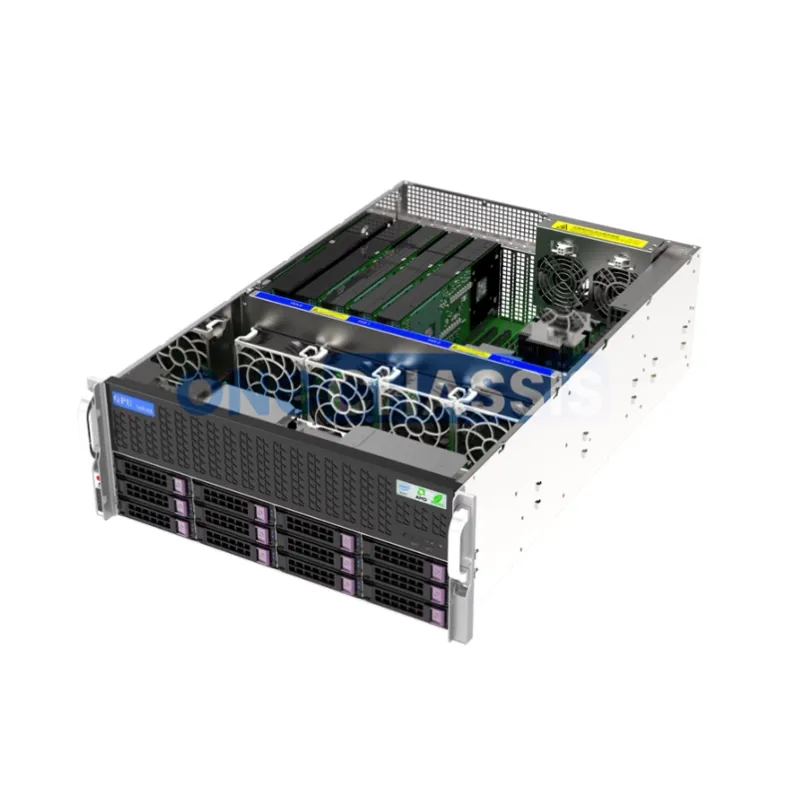
| Drive bays | 4 × 3.5" + 2 × 2.5" | 12 × 3.5" hot-swap + 2 internal | 8 × 3.5" hot-swap (2.5" supported) | 5 × 3.5" hot-swap |
| Backplane | not published | 12× SAS/SATA 12 Gb/s direct, 12× expander, or 8× SAS/SATA + 4× U.2 | 6/12 Gb/s SATA/SAS direct | SATA / U.2 |
| Cooling | 3 × 12038 + 2 × 8038 | 4 × 9238 hot-swap PWM + 2 × 8038 rear | 3 × 12038 standard, optional high-speed | 3 × 8038 front + 3 × 12038 rear, BMC |
| Power | 1+1 redundant | 1300–2700 W CRPS, 1+1 | single 2U, 1+1 redundant, ATX or CRPS | 2 × 3200 W CRPS, 1+1 |
| Motherboard | 15"×13" / EATX / CEB / ATX / µATX | not published | MAX 13.9"×13" / EEB / CEB / ATX / µATX / ITX | ATX / EATX (EPYC / Xeon) |
| Material | SGCC 1.0 mm | SGCC 1.0 mm | SGCC 1.2 mm | not published |
Three things become visible when the columns are read together.
Depth is the real differentiator. 530, 660 and 780 mm are all "4U". A buyer who specified only the height has left a 250 mm decision to chance.
The storage architectures are not variations, they are different products. Four bays with two 2.5" additions, twelve 3.5" bays with four backplane options, and eight 3.5" bays serve different workloads. If your workload streams from local NVMe, the twelve-bay platform with the 8+4 U.2 option is a different answer from the four-bay platform.
The power philosophies differ more than the wattages. A single 2U supply, a 1+1 pair, and a 2 × 3200 W CRPS pair describe three levels of redundancy intent. The number alone does not.
5. The three fields most often left blank
In practice, three of the twelve are the ones that come back incomplete.
Cabinet usable depth. Buyers frequently give the cabinet's external depth rather than the distance between mounting rails. These differ, and the rail kit spans the second number.
Exact board model. "EPYC, ATX" is a family, not a model. The platform's supported-board list is specific for a reason, and a board outside it needs an explicit confirmation rather than an assumption.
Installed GPU length. Card datasheets quote body length. The assembly adds the power connector and the cable bend radius. This is the single most common cause of a late fit surprise, and it is avoidable by measuring the installed assembly rather than reading the card's marketing spec.
Filling these three turns a standard-configuration price into a price for your configuration. It also makes the answer comparable across suppliers, because each one is responding to the same twelve facts.
6. What this article cannot confirm
- No fit guarantee. The values cited are published platform specifications. Whether your specific card and board fit a specific chassis is confirmed against the configuration, not against this table.
- No price, lead time or minimum quantity. Those follow from the completed specification and are not stated here.
- No performance claim. No throughput, benchmark or thermal result is stated for any configuration.
- No recommendation between the four models. They are different answers, not a ranking.
- No demand claim. The twelve fields are derived from published specifications for platforms in this range. They are not derived from keyword volume data.
Where a cell above is blank, the model does not publish that value. Do not fill it by inference from a sibling model — ask instead, because the per-project confirmation is exactly what that blank is telling you.
7. Next step
Complete the twelve fields, then request a configuration review with that sheet attached. A supplier answering your twelve facts is doing a fit check; a supplier answering a form factor is quoting a catalogue item.
If the platform envelope is still open rather than fixed at 4U, how to choose a GPU server chassis for an AI build covers the five constraints that come first. If you are still choosing between four and eight GPUs, matching GPU density to workload covers that decision. If you are deciding how much of the platform to take responsibility for, barebone platform or bare chassis covers the supply-scope split.
The four 4U platforms compared above are documented individually: OCG4780-4H5-H, OCG4680-4H8-H, OCG4660-4H12-C and OCG4U530A-L. The full range, including 5U, 6U and 7U directions, is on the products page.