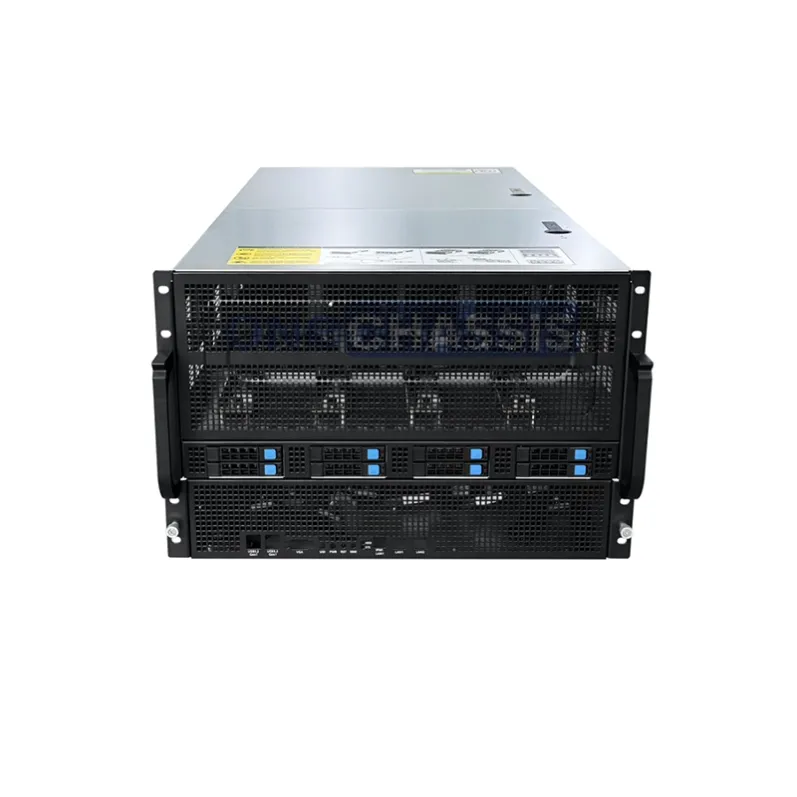
Deploying RTX PRO 6000 in a 7U Barebone: Power, Cooling and Rack Planning
What to plan before installing RTX PRO 6000 class GPUs in a 7U 8-GPU barebone: power budget, airflow direction, card envelope and the checks that belong before the order.
By Mark Lee, Technical Sales and Platform Configuration, GPUBAREBONE
RTX PRO 6000 class cards change the assumptions that a multi-GPU platform was planned around. They are physically large, they draw power in a different band from the consumer-class cards many integrators have used before, and they need airflow that matches their own thermal design. This article sets out what to settle before a 7U 8-GPU barebone is specified for this class of card.
1. Start from the card envelope, not the GPU count
The first number that decides whether a platform works is the physical card envelope: length, height and thickness. A 7U 8-GPU barebone in this range is specified around a maximum supported GPU size of 360 x 157 x 85 mm. A card inside that envelope fits mechanically. A card outside it does not, regardless of how many slots the chassis advertises.
Card thickness matters separately from length. The slot spacing in the platform is stated as either 92 mm or 85 mm depending on how the eight positions are loaded. That spacing determines whether four-slot cards can be installed across the full set of positions, or whether some positions have to be left empty.
2. Power is a budget, not a rating
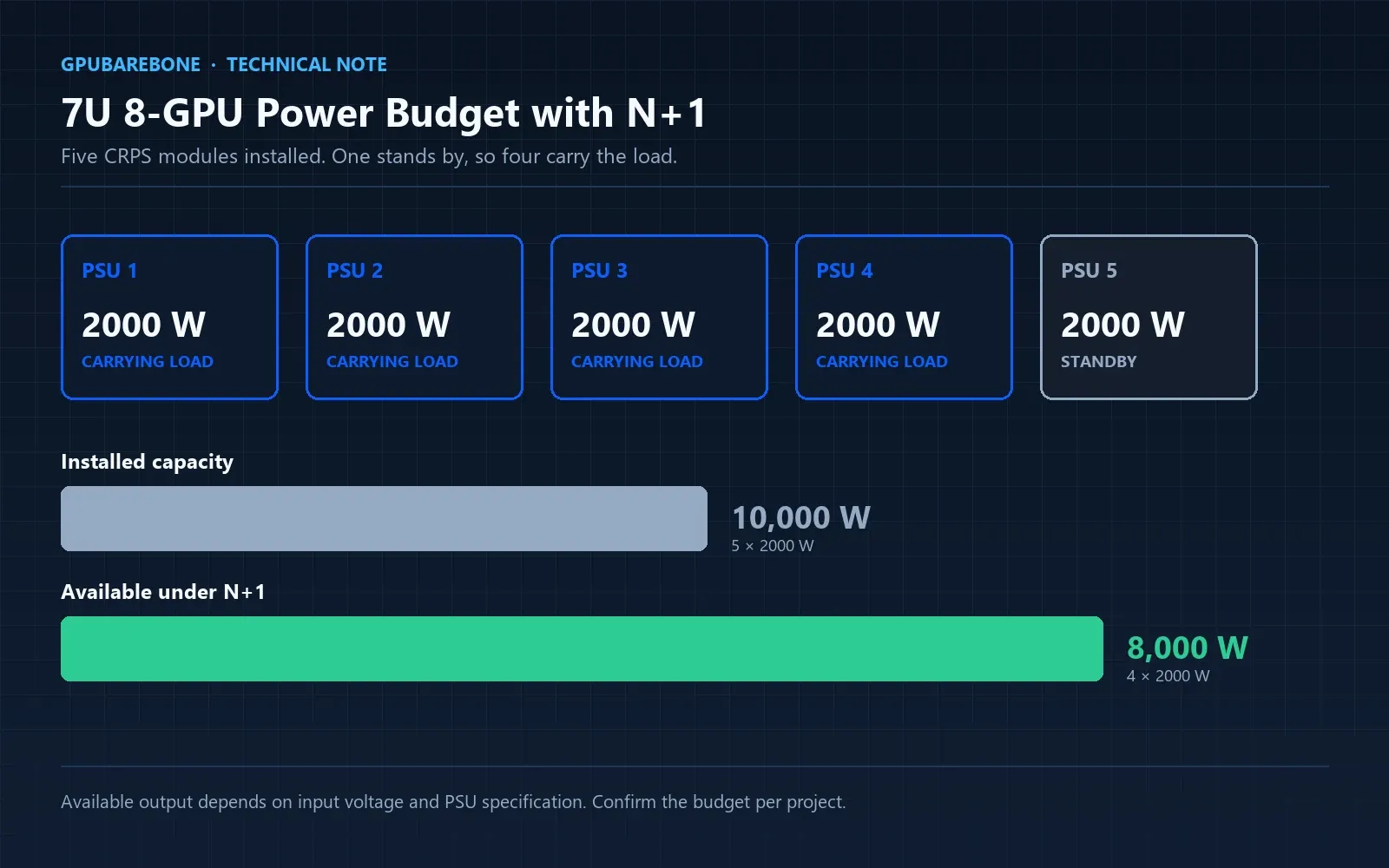
A 7U barebone in this range carries five CRPS power modules at 2000W each, arranged for N+N or N+1 redundancy. The figure that matters for planning is not the sum, because redundancy reserves part of it.
With N+1 redundancy and five modules, four modules carry the load while one stands by. The output available to the system is therefore governed by the module count that can be lost without dropping the load, and by the input voltage at the site. A platform specified at 2000W per module does not deliver 10000W to the GPUs when redundancy is required.
Two practical consequences follow. First, the total GPU power budget has to be calculated against the redundant capacity, not the installed capacity. Second, the site's input voltage and circuit capacity have to be confirmed, because the same module produces different output at different input voltages. This is why platform documentation states that available output depends on input voltage and power supply specifications rather than quoting a single figure.
3. Airflow direction has to match the card
Server GPUs are designed for front-to-rear airflow through a rack chassis. A barebone in this range moves air from the front fan wall, across the GPU bays, through a central fan module, and out the rear. The platform is specified for front-to-rear airflow across the GPU and motherboard zones.
What that means in practice: the card's own fan behaviour, the chassis fan curve, and the cable routing in the GPU bay all interact. Cables routed across the airflow path, or cards whose airflow assumption differs from the chassis direction, produce higher operating temperatures than the platform's thermal design anticipates.
Airflow ducting is a per-project item on these platforms. A duct that suits one card model may not suit another, so the cooling configuration is confirmed against the specific card rather than assumed from the chassis rating.
4. Rack space and handling
A 7U 8-GPU barebone in this range measures approximately 900 x 447 x 308 mm (D x W x H) and ships at around 53 kg gross before GPUs are installed. Three consequences for rack planning:
Depth. The chassis depth has to fit the rack's usable depth with cable clearance behind it. Power cables and, where used, liquid cooling lines need space the chassis length does not account for.
Weight. A loaded 7U platform plus eight GPUs plus power supplies is a two-person lift. Rail kits are typically optional and should be part of the order rather than sourced later.
Heat density. Eight GPUs in 7U concentrates heat in a small rack volume. Whether the room's cooling can remove that heat at the rack level is a site question, not a chassis question.
5. The checks that belong before the order
The following are worth confirming in writing before an order is placed, because each one changes the platform specification rather than the assembly:
GPU model and count, with the specific card variant rather than a family name.
Motherboard and CPU, because lane allocation determines what each GPU can be offered.
Site input voltage and circuit capacity, because it sets the real power budget under redundancy.
Rack depth, weight capacity and rail type, because these decide installability rather than performance.
Ambient temperature and rack-level heat rejection, because GPU clocks depend on sustained cooling.
6. What this article cannot confirm
This article does not state that any specific RTX PRO 6000 variant is validated in any specific platform. Platform specifications distinguish between GPUs that are validated, GPUs confirmed per project, and GPUs not covered. It also does not predict thermal perf