PCIe Gen5 in Multi-GPU Barebones: What Actually Limits Signal Integrity
A practical look at what decides whether a PCIe Gen5 x16 GPU link trains at full width: riser length, connector quality, lane allocation and the motherboard's role.
By Mark Lee, Technical Sales and Platform Configuration, GPUBAREBONE
Most multi-GPU projects treat "PCIe Gen5 x16" as a single specification. It is not. The numbers on a chassis datasheet describe what the riser is designed to carry, not what your assembled system will actually negotiate. This article sets out what decides the answer, so the question can be settled before a bill of materials is agreed rather than during bring-up.
1. The gap between rated and negotiated
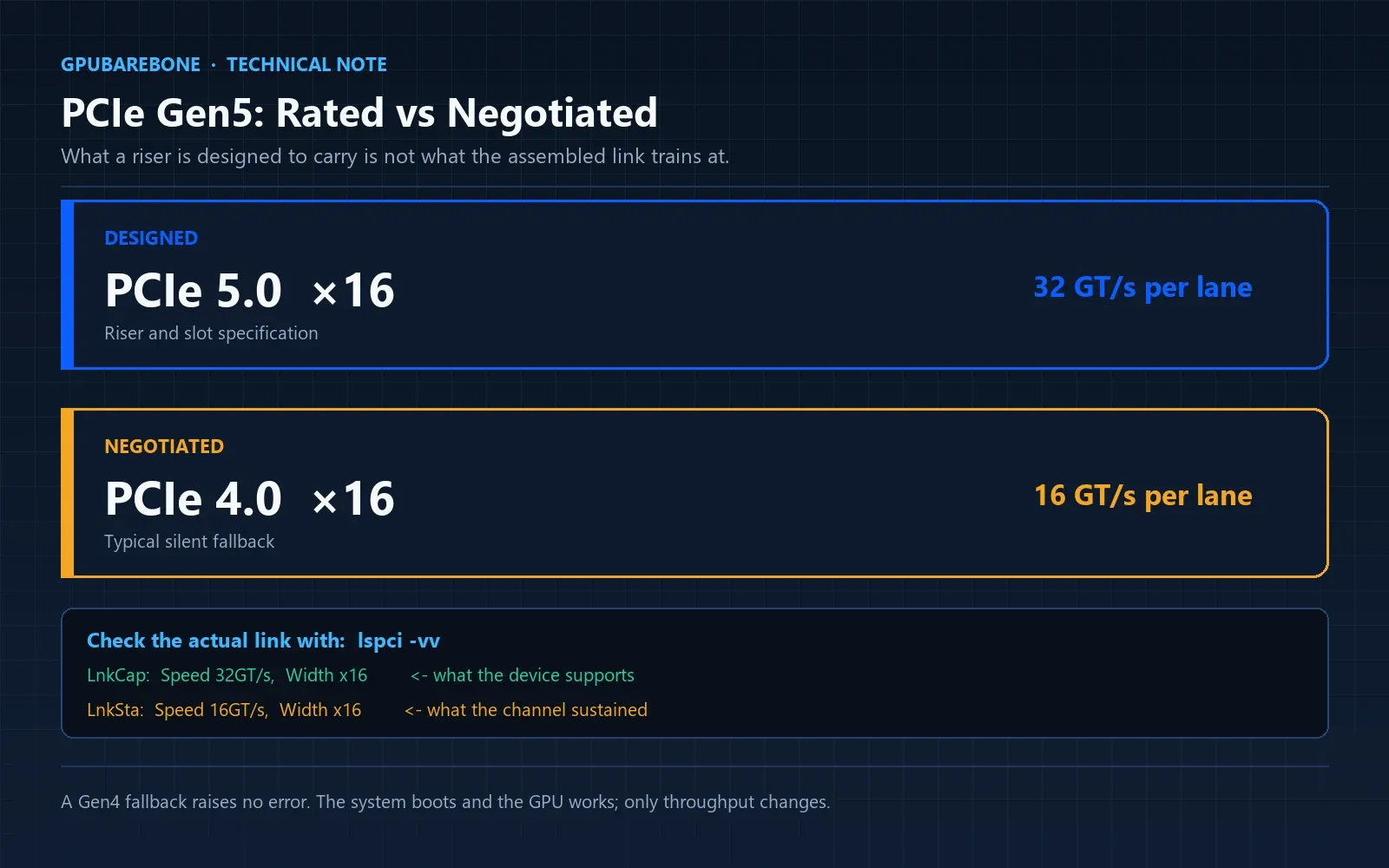
A PCIe Gen5 link is rated at 32 GT/s per lane. A x16 link is sixteen lanes. What a riser is rated for and what a link trains at are two different things: the link trains at the highest rate both endpoints and the channel between them can sustain. When a channel cannot sustain Gen5 signalling, the link typically falls back to Gen4 rather than failing outright. The system still boots, the GPU still works, and the only visible symptom is roughly half the expected bandwidth.
That silent fallback is why "it posted and the GPU is detected" is not evidence that the platform is running as designed. The negotiated link width and speed have to be read explicitly.
2. What the riser contributes
A GPU riser is not a passive wire in practice. Each one involves a connector at the motherboard end, a flexible or rigid cable section, and a slot at the GPU end. Each transition is an impedance discontinuity, and at 32 GT/s the margin for those discontinuities narrows sharply compared with Gen4.
The practical variables are:
Riser length. Longer traces and cables mean more insertion loss. This is why short direct-attach risers behave differently from long cabled assemblies at the same nominal generation.
Connector and cable quality. A riser built for Gen4 may physically fit a Gen5 slot and still not sustain Gen5 signalling. The generation rating on the assembly is a design claim about its channel, and it should be read as such.
Riser topology. Some platforms feed each GPU from a dedicated set of lanes; others use a switch or a bifurcated arrangement. The topology decides how many lanes each GPU can be offered, independent of what the slot is labelled.
3. What the motherboard decides
This is the constraint that chassis specifications cannot answer. The motherboard and CPU determine how many PCIe lanes exist in total, how they are divided across slots, and whether a given combination of populated slots can each receive a full x16.
A platform with eight x16 risers does not imply eight simultaneous x16 links. It means eight physical slots are wired. Whether all eight negotiate x16 depends on the lane budget of the installed CPU and the board's bifurcation design. This is why platform documentation on this site states that actual link width depends on motherboard, CPU and slot allocation rather than quoting a single number.
4. Reading the link you actually got
Once the system is assembled, the negotiated state is observable rather than assumed. On Linux, lspci -vv reports both the maximum link width and speed a device supports and the width and speed it is currently running at. Those two values are printed separately for exactly this reason. A GPU reporting a maximum of x16 Gen5 and a current state of x8 Gen4 is telling you the channel did not sustain the intended configuration.
Reading that output before installing the operating system and the workload is worth the few minutes, because the fallback behaviour is otherwise invisible. The machine is stable, the driver loads, and the only difference is throughput that shows up later as slower training runs or lower inference throughput.
Two other signals are worth checking at the same time: whether every expected GPU is enumerated, and whether any of them sits behind a different upstream bridge than expected. A GPU behind a switch port and a GPU directly on a CPU root complex are not the same configuration, even when both report the same negotiated width.
5. Where the risk concentrates in an eight-GPU build
Density increases the number of link edges that have to work simultaneously. In a four-GPU platform, four riser assemblies each have to sustain their channel. In an eight-GPU platform there are eight, plus whatever switch or bifurcation logic distributes the lanes between them.
That matters because a single under-performing riser in an eight-GPU build degrades one GPU while the other seven look normal. The platform appears healthy in aggregate, and the degraded card is only found by checking each device individually. This is why per-GPU verification is worth doing rather than sampling one card and treating the result as representative.
6. Why the answers are project-specific
Three quantities have to be known together before a PCIe configuration can be confirmed: the GPU model and its lane requirement, the motherboard and CPU lane budget, and the riser generation and topology. Change any one and the achievable result changes.
That is also why a barebone platform is quoted as a barebone. The chassis, risers, power and cooling are the parts that can be specified in advance. The combination that determines negotiated link width is assembled per project.
7. What this article cannot confirm
No statement here guarantees that a particular GPU will negotiate Gen5 x16 in a particular chassis with a particular motherboard. Signalling margin depends on the exact assembled configuration, including cable routing and the specific riser assemblies supplied. Validation is a per-project activity against the actual bill of materials.
This article als